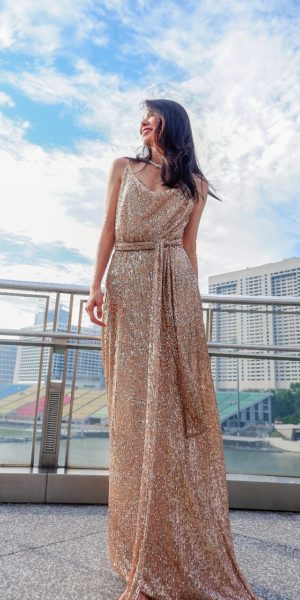

The public perception of fashion design is often shaped by runway finales, celebrity red carpet moments, and glossy editorial campaigns. This glamorous exterior obscures the demanding, disciplined reality of garment creation. Developing a cohesive collection requires far more than artistic instinct. It is an intricate, multi-stage discipline that bridges artistic inspiration, historical scholarship, material science, pattern architecture, and commercial strategy.
A successful fashion designer must operate simultaneously as a visionary artist and an analytical industrial planner. From the initial conceptual spark to the final presentation of production-ready garments, the creative journey follows a structured trajectory designed to turn abstract concepts into wearable, commercially viable collections.
Conceptual Research and Narrative Development
Every compelling collection begins with a defined narrative. Rather than creating disparate individual garments, a fashion designer builds an immersive visual world anchored in rigorous cultural and historical research.
During the initial conceptual stage, designers gather diverse reference materials to shape their thematic direction:
-
Socio-cultural and historical exploration: Designers dive deep into specific art movements, architectural styles, subcultural youth movements, or historic periods. Exploring historical archives reveals foundational garment construction methods and distinctive silhouettes that can be reinterpreted for modern consumers.
-
Mood board synthesis: Reference imagery, fine art photographs, vintage textile fragments, color swatches, and literary passages are organized onto expansive mood boards. This collage serves as the conceptual compass, establishing the emotional atmosphere and thematic constraints for the entire season.
-
Palette formulation: Designers select core base neutrals and dynamic accent hues. These shades are matched to standardized industrial color systems, such as Pantone textile swatches, to ensure complete consistency across future dye lots and fabric suppliers.
This disciplined research phase provides the intellectual framework that gives a collection emotional resonance and narrative cohesion.
Sourcing Materials and Tactile Exploration
Before sketching finalized garment silhouettes, a designer must source the textiles that will bring the concept to life. The physical properties of a fabric, including weight, elasticity, drape, weave structure, and surface finish, dictate what can and cannot be engineered structurally on the human form.
The textile selection process involves several critical steps:
-
Attending global fabric trade fairs: Designers visit major textile expositions, such as Premiere Vision in Paris or Milano Unica in Milan, to review new weaves, sustainable yarns, and finishing techniques developed by specialized regional mills.
-
Ordering sample yardage: Small quantities of prospective fabrics are brought into the design studio to evaluate their physical performance, stretch resistance, and surface feel under direct studio lighting.
-
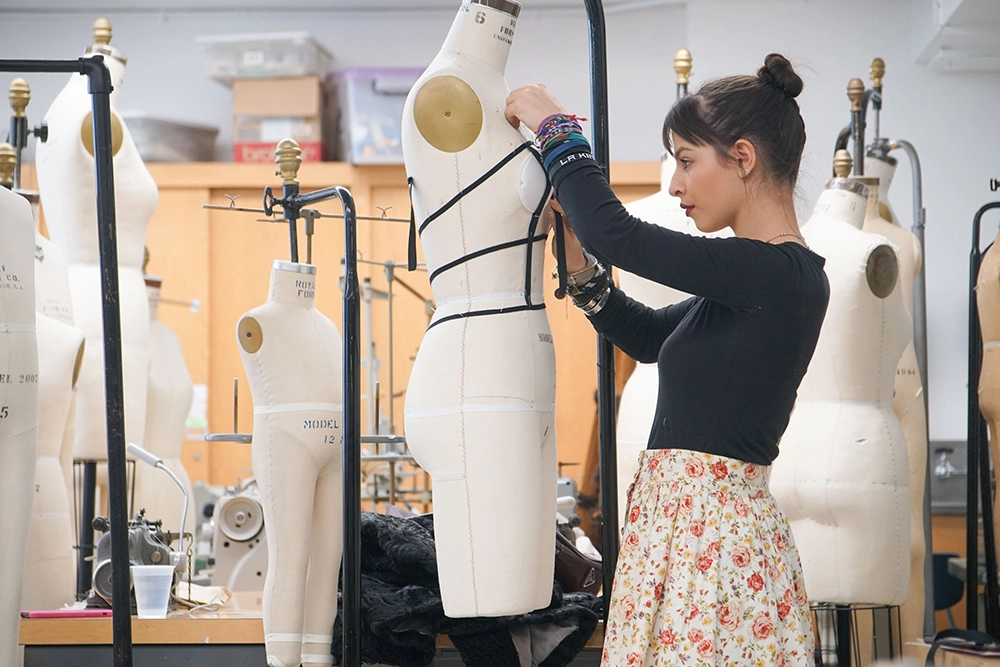
Fabric testing and drape trials: Raw materials are pinned, gathered, pleated, and manipulated directly on tailoring forms to assess how they fold, fall, and hold structural volume.
-
Developing custom trims and hardware: Zippers, buttons, buckles, decorative bindings, and lining textiles are custom-engineered or sourced to align seamlessly with the collection overall visual theme.
Textile exploration ensures that aesthetic concepts are grounded in the physical reality of fabric behavior.
Ideation, Sketching, and Silhouette Development
Once materials are selected and thematic parameters are defined, the designer moves to rapid visual ideation. This stage translates conceptual mood boards into concrete silhouettes and garment specifications.
The sketching phase bridges artistic expression and technical documentation:
-
Croquis sketching: Designers produce hundreds of rapid, expressive hand sketches or digital illustrations on stylized fashion figures known as croquis. This spontaneous phase explores diverse silhouettes, seam lines, collar variations, and hem lengths without self-censorship.
-
Curating the range: From hundreds of preliminary drawings, the designer edits the selection down to a balanced lineup of garments, including coats, trousers, knitwear, skirts, and dresses. The edited collection must tell a coherent story while providing commercial versatility across different body types and environments.
-
Technical flat drawings: Expressive sketches are converted into precise, two-dimensional technical flats using computer-aided design software. These orthographic drawings detail exact seam placements, pocket dimensions, stitch styles, button spacing, and zipper lengths, serving as the blueprint for patternmakers.
These detailed flat drawings act as the universal communication bridge between design teams, pattern cutters, and factory production units.
3D Prototyping, Patternmaking, and Toile Fitting
Translating two-dimensional technical sketches into three-dimensional garments is one of the most technically demanding phases of the creative lifecycle. This stage is carried out through meticulous pattern engineering and prototype construction.
Key technical processes include:
-
Draping or flat pattern drafting: Master patternmakers draft paper or digital pattern blocks from scratch, or drape raw, unbleached cotton muslin (known as a toile) directly onto an anatomical dress form to establish exact proportions.
-
Toile creation: The preliminary pattern is cut and sewn in plain muslin or sample fabric. Muslin prototypes allow the design team to assess the volume, balance, and silhouette of a garment without wasting expensive final textiles.
-
Fit model sessions: The toile is evaluated on a professional fit model who represents the brand target proportions. The designer cuts into the muslin, pins excess fabric, shifts dart placements, and adjusts sleeve pitch while the model moves, sits, and walks.
-
Digitizing pattern modifications: Adjustments made during the fitting are transferred back to the master pattern software, refining the digital cuts before production starts in the final fabric.
Prototyping ensures that garments look striking on the hanger and drape naturally on the human body during active movement.
Sampling and Creating the Technical Pack
Once the prototype fits correctly in muslin, the studio constructs the initial sample in the final fashion fabric, complete with interior linings, functional interfacing, and custom hardware.
Finalizing the design for mass or small-batch manufacturing requires creating a comprehensive technical package, commonly called a tech pack:
-
Bill of materials: A detailed list identifying every single component needed to assemble the garment, from shell fabrics and contrast facings to thread weight, elastic bands, care labels, and brand tags.
-
Grading tables: A complete measurement specification chart indicating how pattern pieces must expand or contract proportionally across standard consumer sizes, from extra-small to plus sizes.
-
Sewing construction instructions: Step-by-step assembly diagrams specifying stitch densities (stitches per inch), seam finishing methods (such as overlock, French, or flat-felled seams), and press temperatures.
-
Sample inspection: The finished fashion fabric sample is inspected for tensile strength, seam integrity, shrinkage after washing, and colorfastness.
The tech pack serves as a legally binding document between the designer and the manufacturing partner, ensuring that mass-produced units mirror the approved prototype.
Presentation and Commercial Merchandising
The final stage of the creative cycle bridges the studio with the retail marketplace. A fashion collection must be framed, marketed, and distributed to industry buyers, press outlets, and end consumers.
Steps to commercializing the finished collection include:
-
Lookbook photography and styling: Garments are styled into complete looks, paired with footwear, jewelry, and creative hair and makeup to communicate the original thematic vision to the press.
-
Showroom and runway presentations: Designers present the collection via runway showcases, digital presentations, or wholesale showroom appointments where commercial boutique and department store buyers place forward seasonal orders.
-
Merchandising balance: Creative runway statement pieces, which build brand prestige and generate media coverage, are paired with accessible commercial basics, such as tailored tees, knit sweaters, and leather goods, to drive the fiscal revenue that funds the next creative cycle.
By harmonizing creative expression with disciplined engineering and commercial strategy, a successful fashion designer turns abstract thoughts into cultural statements worn across the world.
Frequently Asked Questions
How long does the entire design process take from initial concept to retail delivery?
For traditional fashion calendars, the full process takes between nine and twelve months. Luxury fashion houses work on collections nearly a year before they reach boutique shelves, spending three to four months on conceptualization and sampling, two months on wholesale sales and order aggregation, and four to six months on industrial manufacturing, quality control, and global shipping.
What is the difference between a creative director and a technical fashion designer?
A creative director oversees the high-level thematic vision, brand identity, marketing campaigns, and overarching aesthetic direction of a fashion house. A technical fashion designer focuses on technical execution, pattern drafting, tech pack generation, fabric grading, and factory quality control to ensure that the creative director concepts can be manufactured reliably.
How do fashion designers forecast future trends before creating a collection?
Designers rely on a mix of trend forecasting agencies like WGSN, historical socio-political analysis, fine art exhibitions, street culture observation, and textile mill innovations. By analyzing consumer behavior shifts, emerging musical subcultures, and macro-economic factors, designers identify upcoming aesthetic directions years before they reach the mainstream retail market.
Why do fashion designers create extreme runway pieces that are never sold in stores?
Avant-garde runway designs serve as artistic marketing tools and proof-of-concept showcases. These extreme pieces capture media attention, establish the creative theme of the season, and build aspirational prestige for the brand. The underlying design motifs, color palettes, and textile innovations are then adapted into wearable, accessible commercial lines that generate the majority of retail revenue.
How do fashion design teams manage fabric waste during the pattern cutting phase?
Designers employ specialized pattern nesting software to arrange digital pattern pieces across a fabric marker with maximum spatial efficiency, aiming for fabric utilization rates above eighty-five percent. Sustainable design houses also utilize zero-waste pattern-making techniques, where pattern pieces interlock like a puzzle, leaving zero excess fabric remnants during the cutting process.
What role does 3D digital design software play in modern fashion creation?
3D digital design programs like CLO 3D and Browzwear allow designers to simulate fabric drape, test fit adjustments, and render realistic prototypes on digital avatars in real time. This technology speeds up the prototyping phase, reduces the financial expense of cutting physical muslins, and decreases textile waste by allowing design teams to refine fit parameters before ordering physical sample yardage.